Integration After Ayahuasca Retreat
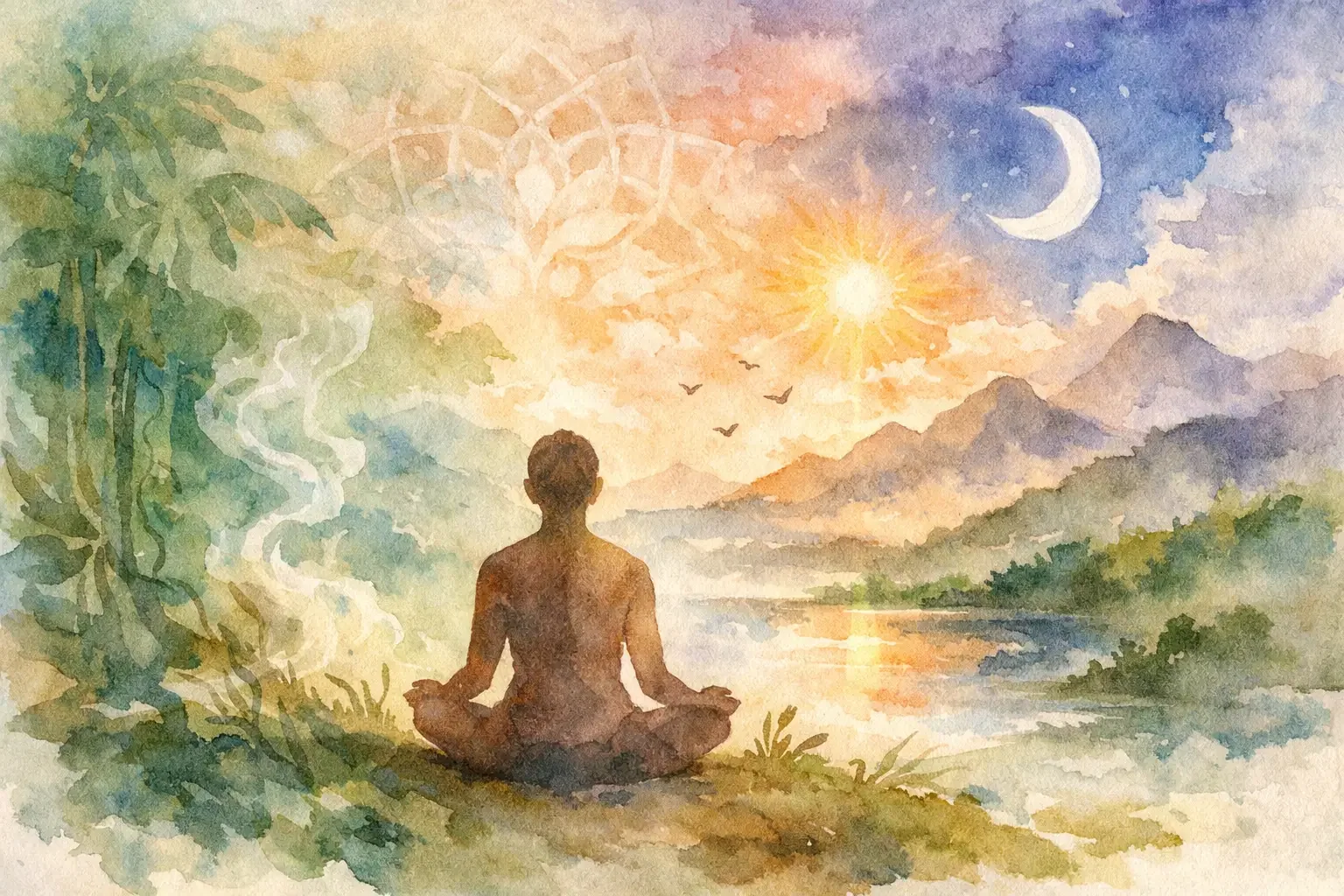
The goal is not to become someone new. The goal is to remember and embody more of who you have always been.
The ceremony ends. You find your way back to ordinary life - the airport, the drive home, the familiar smell of your kitchen. And something in you that has shifted does not yet have words.
This is where the real work begins.
Integration after an ayahuasca retreat is the phase in which visions, emotions, body sensations, and spiritual insight are translated into actual change. Without that translation, even a profound ceremony can fade into memory, leaving behind a sense of wonder that gradually loses its edges, or a tenderness that has nowhere to land.
Many people return from a retreat expecting clarity to hold. Sometimes it does, for a while. More often, what follows is layered. You may feel raw, openhearted, disoriented, grief-stricken, strangely light, or completely ordinary. None of this signals failure. It usually means the medicine touched something real.
The gap between insight and change
Many people discover after ceremony that what hurts is not simply personal trauma. They begin to see the effects of a culture that prizes productivity over presence, achievement over belonging, and distraction over meaning. Integration often involves learning how to live differently within a world that continually pulls attention away from what matters most.
Ayahuasca can illuminate a pattern in a single night. Living differently can take months of steady attention. That gap - between what was seen and what is lived - is where integration lives.
For some, the medicine surfaces unresolved trauma, protective adaptations, or long-buried emotion. For others, it opens spiritual questions that rearrange identity, values, or the way reality is understood. In both cases, the nervous system needs time. Insight alone does not create regulation, relational repair, or a new way of inhabiting a life.
It is in the integration phase that the work really begins. Many people want to experience a change in their life, but they are not willing to make the changes necessary to bring the change they want about. That is not a criticism. It is an honest observation about how transformation actually moves in a human being - not as a single event, but as a slow reorientation of attention, behavior, and relationship.
This is also why people who are high-functioning in daily life sometimes find integration harder than expected. The very capacities that make someone effective - self-reliance, control, intellectual strength - can become barriers when the experience is asking for honesty, vulnerability, or the willingness to grieve. Integration asks for something quieter than self-mastery.
What integration actually involves
Integration is not simply reviewing what happened in ceremony. It is a guided process of helping the experience find its proper place in your mind, body, relationships, and choices.
At its best, it has several dimensions:
Meaning-making: Reflecting on symbols, memories, and realizations without rushing to reduce them into neat conclusions. What was shown? What felt healing? What remains unresolved?
Nervous system support: Sleep, rest, movement, breath, and pacing help the body metabolize intensity. This is not secondary to the psychological work. It is part of it.
Emotional processing: Grief, fear, anger, wonder, and tenderness can be felt without becoming overwhelming - especially when held in a supported container.
Embodiment: Insight becomes visible in how you speak, set boundaries, work, love, and live. This is often the most confronting dimension, and the most essential.
It is easier to cherish a mystical revelation than to tell the truth in a struggling relationship. It is easier to journal about self-worth than to stop overworking. Real integration is often quieter and less glamorous than the retreat itself, but it is where transformation becomes trustworthy.
The first days back
The period immediately after a retreat deserves care. If possible, avoid rushing back into a packed schedule, heavy socializing, or constant digital input. After deep medicine work, the psyche is often more permeable. Emotional sensitivity, unusual tiredness, and a low threshold for overstimulation are common and appropriate.
Simple structure helps. Eat nourishing food. Hydrate. Sleep as much as your body needs. Spend time in silence. Write down what you remember before the mind begins editing the experience into a more acceptable story.
This is also not the time to make sweeping decisions from a heightened state. If you feel a strong pull to quit your job, end a relationship, or completely redirect your life, let that impulse breathe. Some insights are immediately actionable. Others need testing against ordinary life before they can be trusted. Grounded discernment - not post-retreat urgency - is the right guide.
Common challenges
Feeling worse for a period of time after a retreat can be part of the process. This is not always the case, and severe destabilization should be taken seriously, but temporary difficulty does not automatically mean something went wrong.
Some people experience emotional flooding - old grief, fear, or anger rising now that the ceremony's container has ended. Others feel spiritually opened but practically disoriented, as though the old identity no longer fits and a new one has not yet formed. Some notice relationship dynamics they had previously normalized, or feel flat and disappointed because nothing changed overnight.
There can also be a pull to chase the experience. If the retreat brought awe, relief, or a sense of belonging, ordinary life can seem dull by comparison. But integration is not about recreating the peak. It is about becoming more available to reality - including its unfinished and uncomfortable dimensions.
In IFS terms, what surfaced during the ceremony may be an exiled part making contact for the first time. The medicine created the opening. But exiles rarely stay available without the right support. Protector parts will eventually return to do their job. Integration is the work of building enough safety - internally and externally - that the material revealed in ceremony does not need to be guarded against again.
A grounded framework
A useful approach to this phase moves through three questions:
What happened? Revisit the experience carefully, without forcing certainty. Notice patterns, themes, and emotionally charged moments. What felt healing? What felt unresolved? What seemed somatic, relational, or ancestral?
What is it asking of me? This is where the experience meets ethical and practical life. If you saw how much you abandon yourself, the question is not whether the ceremony was profound. The question is what self-abandonment looks like on a Tuesday afternoon, and what one honest change would look like by the end of the week.
What support do I need to live it? You may need coaching, trauma-informed integration work, somatic support, or simply more time and structure than expected. Insight that is unsupported can become destabilizing. Supported insight becomes healing.
Many people return from ceremony searching for how to hold onto what they experienced. Yet healing is rarely about holding onto a state. More often it is a process of remembering what has always been present beneath the noise, the adaptations, and the strategies that once helped us survive.
The role of the body
Ayahuasca experiences are often described through vision, memory, and emotion, but the body is central to integration. Many patterns that surface in ceremony are not just ideas. They are held in breath, musculature, posture, and cycles of activation and collapse.
Gentle movement, breathwork, rest, time in nature, and trauma-informed somatic practices help the system process what the mind only partially understands. If your body feels agitated, numb, or exhausted after a retreat, that is meaningful information.
There is a difference between catharsis and completion. A powerful release in ceremony may open a process, but the body often needs repeated experiences of safety and attunement before something truly settles. Slow is often wiser than intense.
Integration in the context of daily life
The quality of integration will eventually show up in ordinary settings - in how you relate at work, how you speak in close relationships, and where you notice a gap between how you are living and what you now know to be true.
This can be clarifying and destabilizing at the same time. Not every realization requires immediate external change. Sometimes the first step is internal honesty. Sometimes it is a new boundary, a different pace, or a difficult conversation. Larger life changes, when they are real, tend to emerge from grounded discernment rather than urgency.
The Amazonian traditions from which ayahuasca comes have long understood that the medicine opens a process, not a destination. The curandero, the icaro, the maloca - these are containers, not just ceremonies. They exist precisely because what is revealed in expanded states requires ongoing relationship, community, and practice to become lived reality. That principle applies whether you are sitting in a jungle maloca or returning home to Northern California.
When to seek skilled support
There is wisdom in not doing this alone. If you feel persistently anxious, dissociated, flooded, or unable to function after a retreat, skilled integration support can make a significant difference. The same is true if the experience surfaced trauma, attachment wounds, or spiritual material you do not know how to contextualize.
Good support does not impose meaning onto your experience. It helps you stay in honest relationship with what arose - bridging psychological depth with grounded discernment, and inner symbolic material with the very human realities of your nervous system, your relationships, and your life structure.
Healing the Modern Soul offers a comprehensive framework for exactly this phase - preparation, inner work, and the practices that allow insight to become embodied change over time.
What lasting integration looks like
Indigenous traditions have long understood that healing is not merely the removal of symptoms. It is the restoration of relationship — with oneself, with community, with nature, and with the deeper dimensions of life that modern culture often forgets.
Lasting change is usually quieter than people expect. It often looks like more honesty, more capacity to feel without shutting down, more discernment in relationships, and less appetite for living against your own nature. It can look like grief that finally moves, or a nervous system that no longer lives on constant alert.
You do not need to preserve the intensity of the retreat to honor it. The measure is simpler: whether the experience is making you more real, more responsible, and more whole. Whether what was shown is slowly becoming how you live.
The medicine may open the door. Integration is how you walk through it - with your feet on the ground, your heart intact, and your life gradually shaped by what you now know.
The goal is not to become someone new. The goal is to remember and embody more of who you have always been.
Continue exploring
If this article resonates, Chapter 11 of Healing the Modern Soul explores psychedelic integration as imperative for healing, self-awareness, and transformation. The book weaves together ancient wisdom traditions, contemporary psychology, sacred practices, and decades of experience guiding people through profound life transitions.
Explore the book, companion resources, media appearances, and educational materials on the Healing the Modern Soul Book Site.
If you are ready to bring skilled support to what emerged in your experience, I offer preparation, guidance, and integration work rooted in both indigenous wisdom traditions and contemporary therapeutic frameworks including IFS, NLP, and somatic practice.
To explore working together, reach out directly at PsychedelicTherapyCoaching@proton.me.
To go deeper into the ideas behind this work, Healing the Modern Soul is available here on Amazon